By: Justin Silbert
Cyber risk is a living system. It changes every time a new asset comes online, a vendor gets onboarded, or a patch doesn’t get applied. If your risk management process only moves as fast as your compliance calendar, you’re already behind. Automation isn’t optional — it’s what keeps the loop running.
THE PROBLEM WITH POINT-IN-TIME
Two things reliably undermine cybersecurity programs — not because teams aren’t working hard, but because the process is broken at the foundation:
- Point-in-time assessments create false confidence. By the time findings are documented and reviewed, the environment has already shifted. What was accurate at scan time may already be obsolete.
- Identifying a risk and owning its remediation are two different things. Without a continuous process that assigns accountability and tracks progress, findings accumulate, ownership gets murky, and the gap between “known” and “fixed” becomes its own risk.
The compliance calendar is not the threat actor’s calendar.
WHY A LOOP CHANGES EVERYTHING
The most resilient risk management programs don’t operate in straight lines — they operate in loops. A cyclic, iterative model means that new information constantly refreshes your understanding of the environment, priorities are re-evaluated as context changes, and remediation progress is visible to every stakeholder, not just the team that generated the finding.
This isn’t a new concept in theory. In practice, it’s rare — because most organizations lack the tooling and automation to actually sustain it. Manual processes can’t keep pace with dynamic environments. Spreadsheets don’t close the loop.
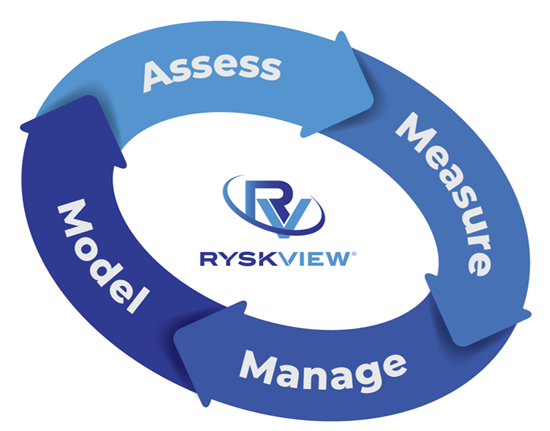
The framework that makes continuous risk management operationally realistic is four stages: Assess, Measure, Manage, and Model. Each stage feeds the next. The output of each cycle becomes the input for the next. And each iteration leaves the organization in a better position than the last.
THE FOUR STAGES
ASSESS — See Everything
You can’t manage what you can’t see. The first stage of effective risk management is continuous, automated inventory — assets, vulnerabilities, and risks across your entire IT environment, including systems you didn’t deliberately deploy.
In federal and DoD environments, this means portfolio-wide visibility: from headquarters down to deployed sites, from managed endpoints to shadow IT. Not a quarterly snapshot. Not an annual audit artifact. A living, continuously updated picture of the attack surface.
The goal of Assess isn’t just coverage — it’s accuracy. Stale data creates false confidence. Real-time discovery means decisions get made on current information.
MEASURE — Not All Risks Are Equal
Once you know what you have, you need to know what it means. A raw vulnerability list doesn’t tell you where to put your limited resources. Context does.
Contextual risk scoring translates findings into prioritized, actionable intelligence. It takes into account the criticality of the system, the nature of the vulnerability, the relevant GRC framework requirements (NIST, FISMA, FedRAMP), and the potential impact — and produces a score that tells your team what to focus on now versus what can wait.
The result: moving from “we have 10,000 open findings” to “here are the 12 that matter most this week.” That’s not just efficiency. That’s operational clarity that keeps ISSOs focused on remediation instead of triage.
MANAGE — Own the Fix, Not Just the Finding
Finding a risk is easy. Fixing it — and proving you fixed it — is where most programs break down.
The Manage stage centralizes POA&Ms, risk registers, and authorization workflows in one stakeholder hub. Every finding gets a named owner. Every remediation gets a deadline and a status. Every update flows bidirectionally: leadership can see enterprise-wide progress; the teams responsible for fixes see their specific priorities.
In practice, this means automated workflows replacing manual processes — fewer steps to update eMASS, fewer hours lost to administrative churn, and cleaner documentation for ATO packages and continuous monitoring requirements. Get-to-green stops being aspirational and becomes a measurable, trackable outcome with clear accountability at every level of the organization.
When an ISSO resolves a finding, the ISSM sees it. When the ISSM signs off, the CISO sees it. No one is chasing status in email.
MODEL — Look Forward, Not Backward
The first three stages tell you where you are. The fourth tells you what it means if something goes wrong.
The Model stage takes your actual, current security posture and runs it against realistic threat scenarios — ransomware, data breach, PHI exfiltration, supply chain compromise — to produce a business impact analysis and a financial impact analysis. Not generic industry benchmarks. Outputs grounded in what controls you actually have in place on specific systems against specific threat types.
This is where risk management crosses from technical operations into business intelligence. The Model stage answers the question leadership is always asking but rarely gets a data-driven answer to: if this happened, what would it cost us?
THE LOOP IN PRACTICE
Consider a common scenario: a new system gets deployed at a remote site that wasn’t captured in the last quarterly review. In a traditional, linear model, it might not appear in a risk assessment for months.
In a continuous loop:
- Assess surfaces the new system automatically
- The Rysk Score is assigned based on the system’s profile and environment
- Manage creates the appropriate POA&Ms and assigns ownership to the responsible ISSO
- Model evaluates the system’s exposure against relevant threat scenarios
- The next Assess cycle starts with that system already in the picture
The loop doesn’t require a trigger. It doesn’t wait for an audit to find what the audit will inevitably find. It operates continuously, which means problems get smaller because they’re caught earlier.
FROM REACTIVE COMPLIANCE TO PROACTIVE RISK MANAGEMENT
Federal and DoD organizations don’t lack compliance frameworks. They lack the operational infrastructure to make those frameworks continuous rather than episodic.
The shift from reactive to proactive isn’t a philosophy change — it’s a process change enabled by automation. Organizations that run a continuous loop aren’t just better positioned for audits. They’re making better decisions between audits — about where to invest, what to prioritize, and how to communicate risk to leadership.
Audit-ready isn’t a sprint you run at the end of the year. It’s the natural byproduct of a process that never stops.
SCHEDULE A DEMO
If your risk management process has a start date and an end date, it has a gap. See how a continuous, automated loop changes what your team can see, act on, and defend. Schedule a Demo.